

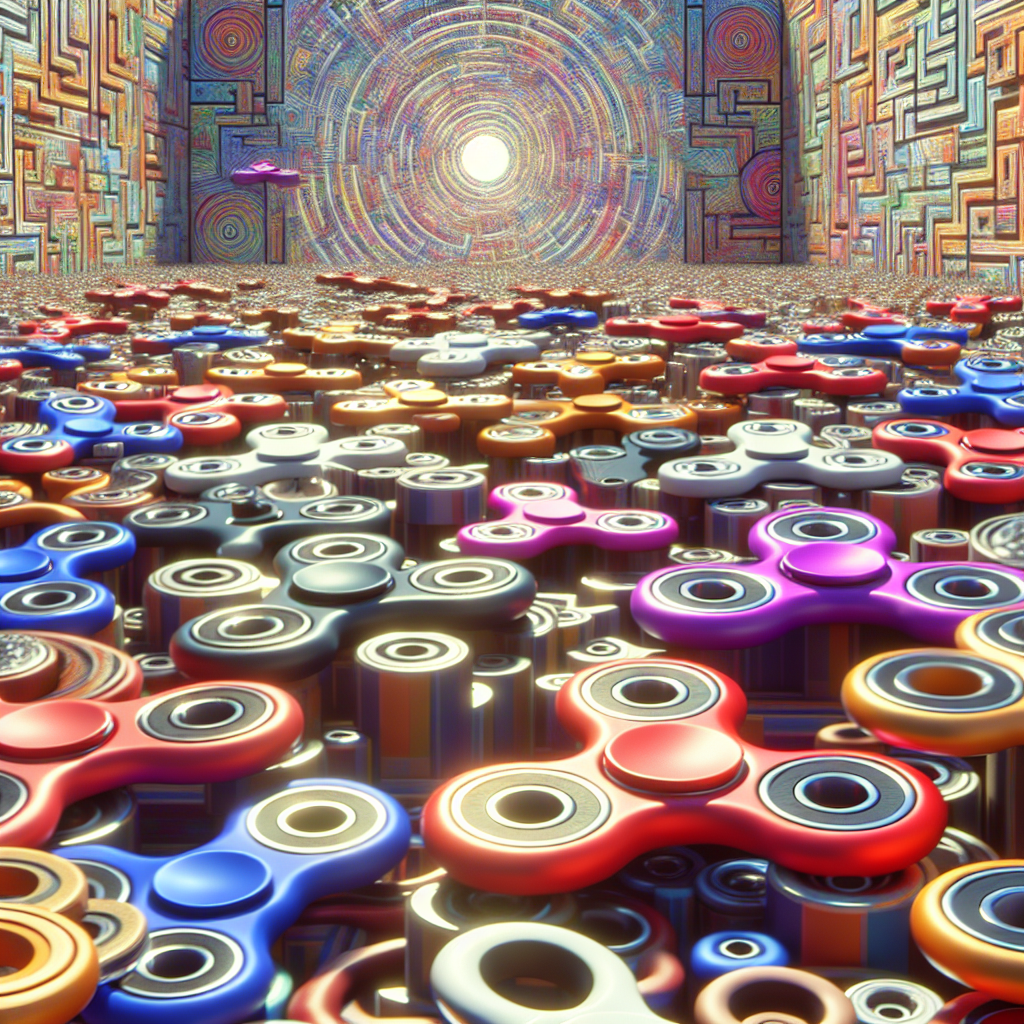
The Enigma of Enthrallment: Deconstructing the Fidget Spinner Phenomenon and Our Love for the Banal
In the 21st century, our world is full of significant scientific discoveries, ground-breaking technological advancement, and mind-blowing telematic practices. Yet, every now and then, we collectively find ourselves hypnotized, not by sophisticated tech or cosmic mysteries, but by simple, unassuming objects of mundane existence. Take, for instance, the simple ‘fidget spinner’ – a trifling piece of plastic that gripped us all with its hypnotic rotations. At first glance, the subject might seem banal, but sit tight, dear reader, as we are about to embark on a fascinating journey into our collective psyche, using the lens of the fidget spinner.
When the mundane meets marketing genius
Let’s start from the beginning, the toy itself. A fidget spinner, in essence, is nothing more than a piece of plastic set in motion by manually spinning it. One might wonder, is this really worthy of global obsession or the extensive media coverage it got? On the surface, the fidget spinner seems deceptively simple and pointless, but scratch underneath and you could spot hints of a marketing masterstroke.
Here, we delve into the genius of Abraham Maslow, famed for his ‘Hierarchy of Needs.’ He postulates that atop the human needs pyramid lies the desire for ‘Self-Actualization,’ which is the human quest for personal growth and the potential we strive to fulfill. Might such trivial toys like fidget spinners serve a bigger purpose than we initially perceive, helping us tap into our intrinsic need for sustained concentration, focus, and perhaps even self-improvement?
Of course, our hypothetical fidget spinning journey to self-actualization might be nothing more than a laughable speculation or, it could be the result of a clever marketing strategy. Flickers of compelling storytelling, clever branding, ingenious promotion all come together to form a perfect storm of advertising tactics that sells a relatively insignificant object as the latest essential gadget. Beware, reader, for in the world of marketing, the trivial and banal can quickly transform into the chic and the vital.
The lure of herd mentality and social contagion
Here’s another fascinating aspect of our obsession with fidget spinners – our inherent susceptibility towards ‘Herd Mentality.’ Much as we’d like to see ourselves as individualistic and independent across fields, the truth is, we humans are social animals. Psychologists coin the phenomenon of large scale adoption of trends, behaviors, and tastes as ‘social contagion.’
Popular culture’s fast pace and ever-evolving nature often drive people to stay ‘in the know,’ and the fidget spinner craze provided the perfect platform. The toy, in this case, is less a standalone object and more a symbol of social unity and shared excitement.
The beauty of the ordinary: The paradoxical fascination within the mundane
The fidget spinner is, in essence, mundane and unabashedly so. But our reaction to it was anything but ordinary. The collective obsession that catapulted this humble toy into the limelight is a testament to our inherent capacity for imagination and wonder towards anything new, unusual, or different.
Though our involvements with fidget spinners might seem pathetic at a glance, it has inadvertently sparked conversations around physics, material science, mindfulness, and psychology. What started as an obsession with a simple spinning toy evolved into discussions and explorations far more profound than any of us anticipated.
Trivial fixation or testament of human progress?
In the grand scheme of the fidget spinner narrative, we spot instances of keen marketing manipulation, a reflection of social dynamics, our creativity, and, undoubtedly, our penchant for silliness. All these elements contribute to the fact that even though we find solace in dismissively labeling such phenomena as ‘trivial’ and ‘silly,’ we can’t resist the allure and ecstasy of such collective obsessions.
Finally, it opens doors for larger questions. Is this collective obsession with trivial things just a recent development, or is it an intrinsic characteristic of our species? Could our tendency to obsess over simple tools and gadgets be more substantial than it appears on the surface? If history serves us correctly, each period of massive prosperity or expansive development in human civilization has had a parallel obsession with something seemingly insignificant – a token of the times perhaps.
Maybe being captivated by the mundane isn’t just another behavioral quirk; it could well be a testament of our collective evolution, a reflection of society’s pulse. A flashing, spinning, tangible reminder of where we are, and how far we’ve come. And who knows what the pervasive obsessions of our times will be? Only time will spin the tale!