
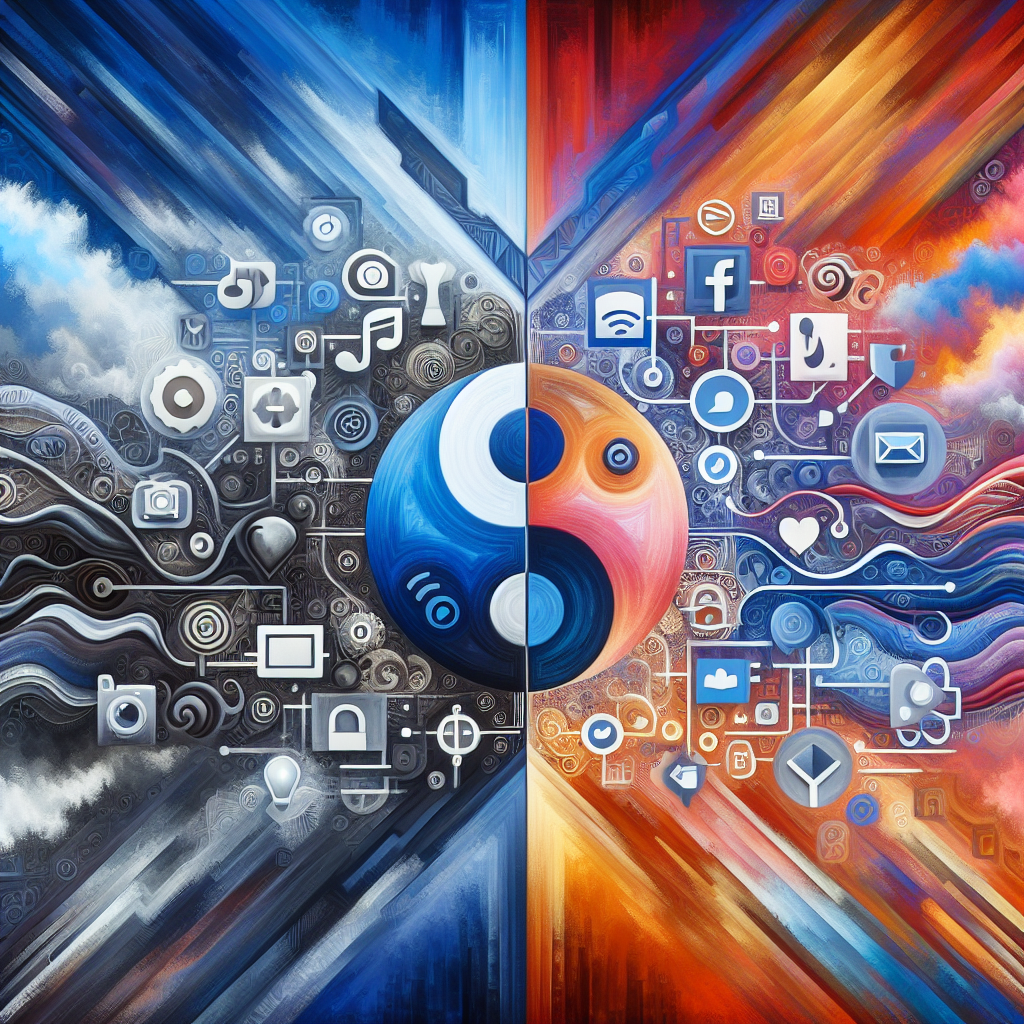
The Ubiquity and Impact of Social Media Today: A Closer Look
Take a moment and consider the world around you. As you walk into a café, ride a subway, sit in a park, or even attend a dinner party, one common thread ties these different environments together. Our collective posture seems to have adopted a new universal language—one of slight stooping, eyes glued to a screen, fingers nimbly moving on a digital keyboard. Essentially, we are all immersed in the world of social media, with its omnipresent influence informing our individual and collective behaviors. May it be images of gourmet breakfasts and exotic vacations, news-driven hashtags, or even humorous cat videos, we are all wired into a matrix of endless online interactions.
As a society, our relationship with these communicative platforms is akin to what psychologist Carl Jung described as the shadow—simultaneously evident and elusive, fascinating yet potentially dangerous. And it is this intrinsic duality that makes a comprehensive understanding of social media that much more crucial.
I Post, Therefore I Am
As we embark on this digital introspection, it’s imperative to acknowledge the paradigm shift in our societal framework caused by the inception of social media. Remember a time when your daily interactions weren’t immortalized on a global, virtual platform? The concept might seem preposterous to Generation Z born in this digital era, but there was, indeed, a point in history where thoughts were unspoken unless expressed verbally, and life’s scenes were captured in heart and memory, not in Instagram filters.
In our present reality, existence seems contingent on constant updates, crafting digital footprints, choreographed selfies and posts meticulously curated for impression management, and often, for acceptance. Those not participating in this new age ritual are often considered detached, or worse, inconsequential. Social media has turned into a validation court where our lives are on perpetual exhibition.
Whisper, Shout, Echo
Despite the innumerable criticisms, social media also serves as a democratic platform for every individual’s voice. Here, a simple tweet can spawn widescale revolutions, bringing to light issues that societal structures often marginalize. However, an equally important caveat is that not all voices transmitted over these platforms are constructive or truthful.
On any given day, your Twitter feed may comprise climate change activists, political leaders, academics, authors, and also conspiracy theorists, trolls feeding on discord, and perhaps the over-excited alien enthusiast. A plethora of voices, screaming into the void, are often difficult to segregate, turning our shared platforms into chaotic forts of misinformation, diluted truth, and often, purposeful falsehoods. This creates a unique phenomenon, an addiction to the amplifying effect of social media, where any whisper can echo into a shout.
Social Media: Savior or Saboteur?
Certain undeniable positive impacts of these platforms have been crucial. Social media has effectively democratized information, giving a voice to many marginalized individuals and communities and bringing large-scale issues to light. The viral nature of such platforms has propelled movements like #BlackLivesMatter and #MeToo into the societal consciousness and helped enforce tangible changes.
However, the darker undercurrents of the same platforms have also bred a culture of cyber trolling, fake news, dog-whistle politics, and perpetuated discrimination form a different dimension of social media. As we vacillate between the pros and cons, an explorative question lingers—is social media a tool for progress and enlightenment or a breeding ground for societal discord?
Amidst the Noise, an Appeal for Awareness
Concluding this exploration, it’s important to remember that social media, like any tool, reflects those who wield it. Let’s choose not to mindlessly scroll or carelessly retweet. Instead, let’s strive to engage only when it carries purpose, converse when it stimulates intellectual growth and benefits others, provoke only when it dignifies and respects another’s perspective.
As we engage in this shared digital environment, let’s remember to fact-check before we forward, empathize before we comment, listen before we make noise. We must remember that the problem lies not in the existence of social media platforms but rather in our often-unconscious use of them.
The conclusion remains subjective; social media can indeed be a blessing or a curse. It can function as a savior or a saboteur, depending on how we wield it. Therefore, it’s important to remember that the diamonds of positivity, introspection, empathy, and authentic engagement can be found amongst these ever-evolving platforms’ digital rubble. Remember, in this digital landscape, the power to shape society is, quite literally, at our fingertips. So, how would you construct your digital world? The choice is yours.